Overview
Wonderlabs Technologies is a Canadian fintech software house that built digital products for financial clients. During two years there, I was the technical reference for front end and the UX lead in a 3-person front-end team working for Concerto Card Company — a fintech platform that raised $21.2M in Series A funding from PayPal Ventures and Matrix Partners. Concerto's business model was enabling brands and sports organizations to launch co-branded credit card programs. Wonderlabs built and maintained the PWA platform that made that possible, serving 50,000+ users on web, iOS and Android. My role was hybrid throughout: I held both UX and Angular development responsibilities across all initiatives.
Project 1: PayPal Corporate Card Management
PayPal needed a web platform for businesses to manage corporate credit cards issued to their employees — think issuing virtual cards, setting individual spending limits, monitoring transactions across the company, and managing reward programs. The users were finance managers and admins, not consumers. The UX challenge was making a dense, data-heavy B2B tool feel navigable and fast. The technical challenge was managing complex shared state across card portfolios, transaction feeds, and permission levels for different user roles.
My Role on the PayPal Platform
As UX Lead
- Designed the information architecture for the platform — card portfolio views, transaction monitoring, limit management, and reward program flows
- Created the team's design system foundation in Figma and its reusable component library with Storybook and Angular Material, establishing component standards, spacing tokens, and interaction patterns
- Redesigned the onboarding flow through prototyping and testing cycles, increasing user engagement by 15%
- Documented requirements and facilitated alignment sessions between stakeholders and the development team
As Angular Developer
- Built virtual card and spending-limit features with Angular, NgRx, RxJS and Firebase Authentication, covering card management, transaction filtering, and role-based access flows
- Migrated the codebase from Angular 13 to Angular 15 in a monorepo setup, adopting standalone components and the latest framework optimizations
- Integrated REST APIs for real-time card and transaction data, with proper error handling and loading states across all views
- Streamlined the Jenkins CI/CD pipeline, reducing deployment time by 20%, and conducted code reviews while sharing Angular and UX knowledge with teammates
Project 2: White-Label Banking App Framework
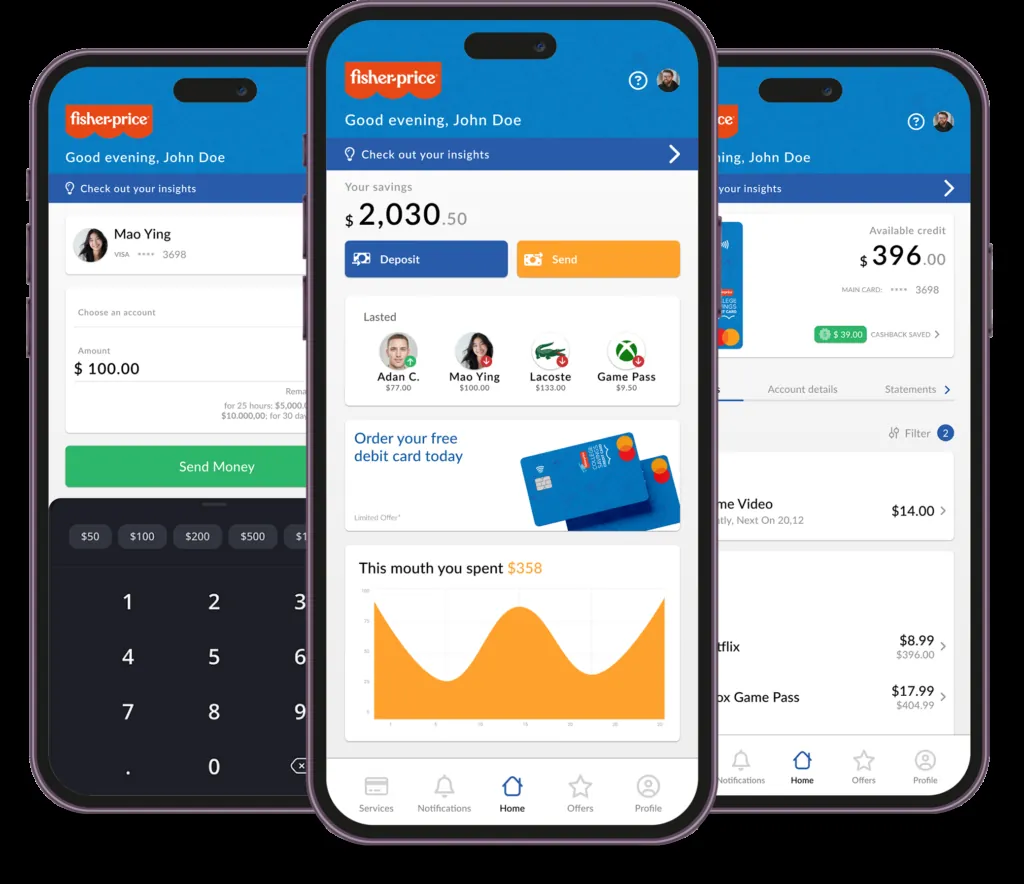
The second initiative was the white-label framework that powered Concerto's core business: enabling brands and sports organizations to launch their own co-branded credit card apps without rebuilding from scratch each time. The framework combined a shared Angular component library with a custom CLI tool that resolved all client-specific configuration at build time — branding, imagery, product catalog, pricing, and content were all injected via a single CLI command per client. This architecture allowed Wonderlabs to ship branded apps for Concerto's partners, including the LA Angels, Baltimore Orioles, and Fisher-Price (whose College Savings Mastercard, built with Gift of College, was covered by NerdWallet and announced by Mattel Corporate). My role was building and maintaining components in the shared library, ensuring full theming support, and providing design feedback on how CLI-driven configuration affected visual consistency across clients.
Results & Impact
The PayPal platform shipped on schedule and the PWA served 50,000+ users across web, iOS and Android. The redesigned onboarding flow increased user engagement by 15%, and streamlining the Jenkins pipeline cut deployment time by 20%. The white-label framework let Concerto grow its client portfolio across MLB teams and consumer brands — each app delivered without rebuilding from scratch — and Concerto announced its $21.2M Series A in 2022 while the platform was in production. Holding both design and development responsibilities throughout meant faster decisions and less friction between design intent and implementation reality.